
Sources checked
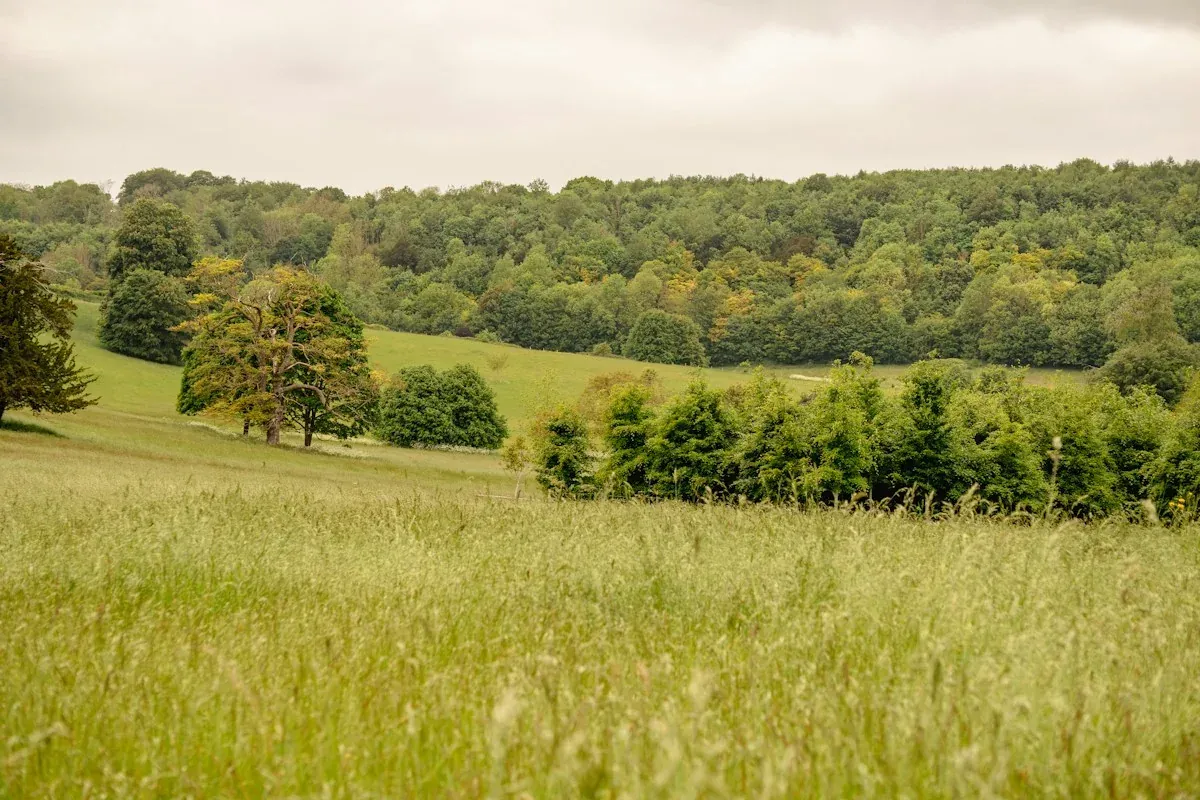
A larger parcel changes the planning job
Fifteen to fifty acres is a landscape to steward as well as a place to live. Roads, boundaries, woods, water, invasive growth, equipment, and ownership decisions may require more attention than the household garden. Start with an inventory and a manageable home core, then assign different objectives to the rest of the land.
These are illustrative concepts, not development schemes. Large acreage does not guarantee multiple homes, agricultural tax treatment, profitable production, grazing capacity, or a safe building location. Investigate local land-use rules, title restrictions, water rights where relevant, and approved services before choosing permanent changes.
Translate acreage into an honest space budget
Fifteen acres are 653,400 square feet; twenty, 871,200; twenty-five, 1,089,000; thirty, 1,306,800; thirty-five, 1,524,600; forty, 1,742,400; and fifty, 2,178,000. Larger totals can conceal substantial inaccessible or sensitive ground, so an area ledger should retain real constraint and habitat allowances.
The illustrative twenty-acre remote-woodland ledger uses 1.2 acres for home and access, 0.6 for intensive growing and work, 4 for possible production, 4.2 for services or constraints, and 10 for light-touch open or habitat space. It totals twenty without pretending that all twenty acres should receive the same maintenance.
Seven concepts for different management problems
| Size | Total area | Illustrative priority |
|---|---|---|
| 15 acres | 653,400 sq ft | Dry-ground home core and wetland screening |
| 20 acres | 871,200 sq ft | Access-funded woodland stewardship |
| 25 acres | 1,089,000 sq ft | Landscape mosaic with clear route priorities |
| 30 acres | 1,306,800 sq ft | Household and possible lease separated |
| 35 acres | 1,524,600 sq ft | Several management units, one daily-work core |
| 40 acres | 1,742,400 sq ft | Existing-asset assessment before new construction |
| 50 acres | 2,178,000 sq ft | Long-range stewardship with a bounded home core |
15 acres: dry-ground home core and wetland screening. Low wet ground occupies a significant share of the parcel. Place provisional intensive projects on suitable ground; retain lowland pending wetland, flood, and drainage assessment. First step: Screen sensitive ground before access construction or clearing. A likely planning error is assuming a larger purchase can absorb an unusable building site.
20 acres: access-funded woodland stewardship. A remote wooded parcel has an existing access route that needs maintenance. Budget road and service access first and keep the home projects close together; use a forest inventory for distant woods. First step: Obtain seasonal access and maintenance quotes before enlarging the managed core. A likely planning error is forgetting annual road upkeep because access already exists.
25 acres: landscape mosaic with clear route priorities. The parcel mixes meadow, woods, and paths used by household members. Separate essential all-weather routes from recreational paths; maintain a small household growing area and broad landscape reserve. First step: Name the route purpose before deciding its surface, width, or maintenance. A likely planning error is upgrading every path to vehicle access without a job that needs it.
30 acres: household and possible lease separated. The household is considering a future agricultural lease while retaining its own core. Keep a prospective lease block distinct from home routes and water systems; feasibility depends on written agreements and permitted uses. First step: Assess access, water, responsibilities, and local use rules before negotiating a lease. A likely planning error is treating another operator's activity as hands-off income without obligations.
35 acres: several management units, one daily-work core. The land is fragmented by slopes and several vegetation types. Give each landscape unit its own objective and schedule rather than stretching a single grid across all thirty-five acres. First step: Inventory the separate units and identify which need professional or contractor input. A likely planning error is a uniform mowing or grazing prescription for very different ground.
40 acres: existing-asset assessment before new construction. An existing barn and mixed open ground are assets, but their condition and allowed use are unverified. Evaluate the barn, access, utilities, and maintenance costs before assigning it a new job; keep the household core small. First step: Get condition, insurance, and use advice before repairs or conversion plans. A likely planning error is assuming an existing agricultural structure is suitable or legal as housing.
50 acres: long-range stewardship with a bounded home core. A substantial mixed parcel calls for long-term financial and succession decisions. Link habitat, access, forest or agricultural objectives, and ownership planning; choose a small area for daily household work. First step: Create a management inventory and succession conversation before adding expensive specialized systems. A likely planning error is building a complex estate around labor or family participation that may change.
Compare ownership, contracting, and possible leasing
Owning equipment offers control but requires storage, maintenance, safe operation, and a workload that justifies it. Contractors or custom hire can handle periodic work, though you need access, scheduling, clear scope, and a reliable provider. A possible agricultural lease shifts some work to another operator but needs defined access, water, fence, insurance, permitted use, and maintenance responsibilities.
Evaluate those choices against actual tasks rather than assuming acreage means you need a tractor or that leasing creates effortless income. Preserve the distinction between the household’s routes and the outside operator’s routes. Keep unverified commercial ideas conditional until their practical and legal requirements are understood.
Create a management record that survives changes
Maintain maps, service records, approvals, route information, contractor contacts, and a calendar for each landscape unit. State the objective: protect habitat, maintain safe access, manage a woodlot, recover pasture, or support household food growing. Review what each action accomplished and what it cost.
For a large parcel, discuss future ownership early. Oregon State University’s succession-planning guidance treats family goals, communication, and professional planning as part of rural land stewardship. Use the conversation to test whether expensive systems depend on labor or family participation that may change. A practical map and written responsibilities are useful now, not only at inheritance time.
Large-parcel FAQs and recurring mistakes
Can I build a family compound on forty acres? Allowed dwellings, access, water, wastewater, and title arrangements must be verified locally; acreage alone does not settle them. Should I clear woods to create a production block? Assess forest value, habitat, erosion, costs, approvals, and the actual objective first.
How much land should I intensively maintain? Begin with the routine your household can sustain and expand from evidence. Avoid converting every acre into a chore, overlooking annual road costs, treating an existing barn as automatically fit for housing, or making long-term commitments without an ownership and succession conversation.
Sources & further reading
Official guidance and original source material used for the factual points in this guide. Planning examples and worksheets are our own illustrations.
- NIST: Revised unit conversion factors
- Oregon State University Extension: Creating a Land Steward property management plan
- Oregon State University Extension: Ties to the land—succession planning for rural landowners
- USDA NRCS: Web Soil Survey
Checked 8 October 2026. Location-specific rules, availability and product specifications can change. Suggest a correction.