
Sources checked · Illustrative concept; no yield or animal-capacity promise
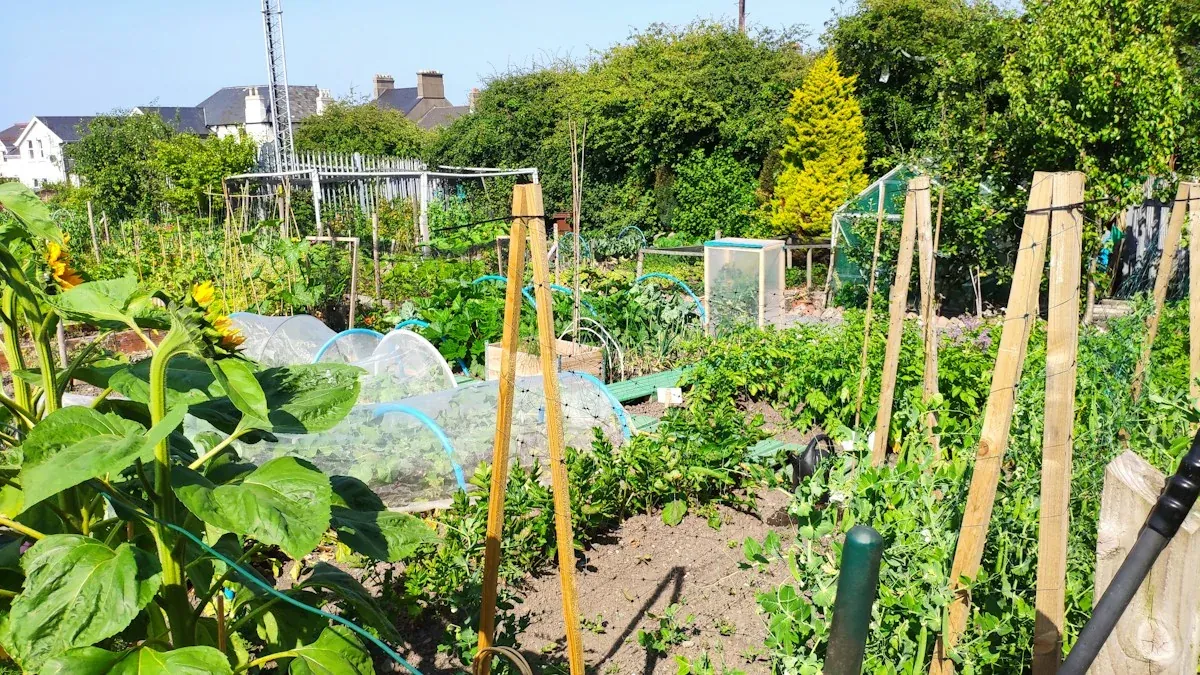
A starting concept for 0.4 acre
A household wants routes that remain useful to people with different mobility needs.
Priority: Access-first growing spaces. Comfortable circulation is part of production: fewer reachable growing areas can be more useful than more beds that household members cannot tend easily.
Reserve generous measured circulation and reachable work areas; grow fewer things if that keeps the routine comfortable.
The size describes total land area, not the amount available for production. Boundaries, existing buildings, rights, slopes, drainage, shade and service arrangements can substantially change the usable portion. Keep those constraints on the base map before drawing new beds, trees or animal areas.
The land-area arithmetic
43,560 × 0.4 = 17,424 sq ft. That total is 1,618.74 square meters. The conversion uses 43,560 square feet per acre; a fractional-acre example should retain its exact fraction where stated.
The areas below are an original teaching scenario and sum to the stated land area. They are not minimum setbacks, a septic design, recommended animal stocking, predicted food yield or permission to build. Replace them with the measured constraints and intended work for your own parcel.
| Area | Illustrative sq ft | Share | What to verify |
|---|---|---|---|
| Home & access | 6,000 | 34.4% | Existing buildings, delivery and everyday routes |
| Intensive growing & work | 1,200 | 6.9% | Sun, water, working paths and care time |
| Perennials or future production | 2,000 | 11.5% | Site suitability, establishment work and long-term access |
| Services & constraint reserve | 3,600 | 20.7% | Actual service areas, constraints and reserve needs |
| Open land or habitat | 4,624 | 26.5% | Habitat, mowing/fire/access requirements and stewardship |
Additional bed area versus wider usable routes
Test carrying tools, turning, and reaching with the people who will use the site; preserve the route if an extra bed would make their routine harder.
Put both choices on the same measured base map. Show the paths, supply route and maintenance access each needs. Compare the setup cost, weekly work, reversibility and the task it helps you perform. An option that produces more on paper may be less useful if you cannot keep up with it.
Start with a manageable first phase
Lay out temporary paths and test carrying, turning, and reaching before beds are fixed.
- Access-first growing spaces
- Lay out temporary paths and test carrying, turning, and reaching before beds are fixed.
Choose a trial with a visible result: a working route, one maintainable growing area or an observation record. Price the trial separately from the eventual full layout. Keep a season of notes about care time, water, weather, harvest and unused space before scaling the plan. Complete one working system before adding several new responsibilities.
Constraints and the failure to avoid
- Mobility and carrying needs differ between users
- Path dimensions must be tested rather than assumed
A common failure in this concept: Narrow paths that fit on paper but become unusable with tools or assisted mobility.
Preserve access for repairs, deliveries and future changes. Record wet areas, existing vegetation and the places services need to occupy. Confirm applicable local permissions and setbacks with the responsible authority. A diagram should organize the proposal, not erase the inconvenient parts of the real site.
Questions to answer on the actual site
- Can each user reach the planned work areas?
- Where can a person turn or set down a load?
- Does the route stay useful as plants mature?
Give each unanswered question an owner, a date and the evidence needed. Use a qualified site assessment where the issue involves drainage, ground conditions, wastewater, structure or another area you cannot establish by observation. Keep the findings alongside the area budget.
Adjust the area ledger for your own priorities
If the allocation is over budget, reduce or postpone a use rather than quietly counting the same ground twice. An unallocated balance can provide useful flexibility, but it is only genuinely available after the constraints have been investigated. Save the assumptions with your printout.
Sources & further reading
Official guidance and original source material used for the factual points in this guide. Planning examples and worksheets are our own illustrations.
- NIST: Revised unit conversion factors
- EPA: Urban agriculture
- Oregon State University Extension: Creating a Land Steward property management plan
Checked 8 October 2026. Location-specific rules, availability and product specifications can change. Suggest a correction.